Choosing a Binocular Exit Pupil for the Conditions You Actually Observe In
The apparent sharpness of a binocular at midday can decline sharply at the end of the day. The problem with a binocular is not necessarily the focus or the magnification, but rather the amount of light which the instrument presents to the observer's eyes. The exit pupil of a binocular is a most useful parameter to relate the advertising specifications to the real life usage. First define your usual viewing hours, then weigh up the factors of brightness, observer comfort, optical size and observer steadiness rather than always opting for the largest objective lens size.
What the exit pupil tells your eye
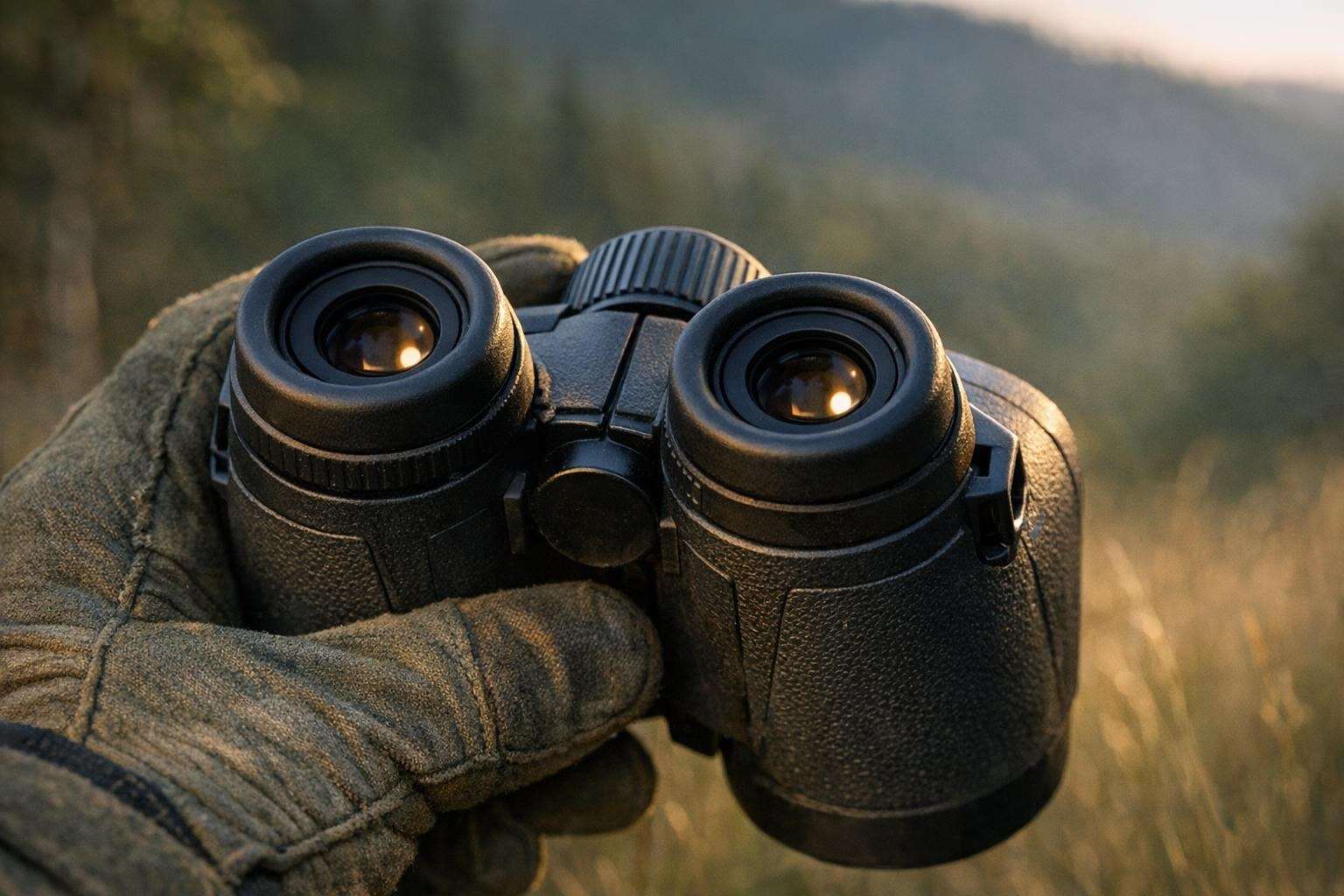
The exit pupil is the small disk of light that you can see behind the eyepiece of a binocular when you hold it away from your eyes. The diameter of the exit pupil is calculated by dividing the diameter of the objective by the magnification. The result indicates how much light will be delivered to your eyes, and not necessarily how bright the image will look.
Whether or not all of this light actually enters the eye depends on the pupil size of the observer. The pupil changes with the amount of light that is shining on it, and also with age, and from person to person. An exit pupil greater than the pupil size of the observer is of no use, it simply does not enter the eye. An exit pupil less than the pupil size of the observer makes viewing more critical as the observer must keep the binoculars very straight, which can be difficult when moving, or when searching for subjects.
Exit pupil size is matched to the intended use of a binocular. A large exit pupil can make a binocular more lenient when low light levels are encountered but, in bright daylight, a smaller exit pupil is completely sufficient and even preferred for a lighter and more handy optical instrument.
Match the specification to your viewing hours
Daytime birding, watching sports, or even reading sign from a distance do not require a large exit pupil as there is plenty of light available for the eye. In these situations a smaller binocular is ideal for being lightweight, small and easy to carry for long periods and for being easily maneuvered into position for quick viewing.
Low-light viewing however is more difficult when the subject is of low contrast. A larger exit pupil helps here because it makes the alignment easier and allows for a more relaxed view. However, a large exit pupil does not necessarily mean that all detail can be resolved with the optics available. The focal length, image quality, image contrast, atmospheric conditions and contrast of the subject all have to be taken into account.
How will you use the binoculars? How often will you be carrying the binoculars and viewing during the day? A compact pair of binoculars for everyday use is more suitable for viewing during the day. A larger pair of binoculars may be more suitable for use at dawn and dusk when viewing wildlife in shaded woodland or on distant hillsides.
The trade-off behind a bigger objective
While a larger objective will enable a larger exit pupil at the same magnification, there are many trade-offs involved. In addition to weight, increased bulk, and an odd shape that doesn't fit well into a harness or small bag, large objectives also tend to be difficult to hold for long periods of time. While a bright-looking binocular may seem like the best choice, in reality it can end up being tiring to carry around.
Note also that, as the magnification increases, the exit pupil will decrease, even when the objective diameter is kept constant. In this way, it is possible to extract more detail from very far away objects in good light, but the image will be less forgiving and more sensitive to hand movement than with a larger exit pupil. Only by increasing the objective diameter will the exit pupil also increase, but that in turn will increase the weight and size of the optics.
For a pair of hunting scopes or rifle scopes the balance between light in the glass for viewing from a fixed position and carrying the scope when moving from location to location is critical. For bird-watching scopes however, the ease with which the user can handle the scopes and acquire a subject in good time may be more important than the best low-light performance.
Check the view instead of trusting the label
What Specifications Do Not Tell You. Look at the specifications of a pair of binoculars with disdain and don't be so impressed. Take a good pair of binoculars to a shop and look through them in the same sort of light in which you will use them most. Find out whether you can see to focus them within a reasonable time and whether the image blackens when you move your head. See how long you can keep looking through them comfortably and then compare them.
Unless you are looking for brightness, there are many other factors to consider when assessing optical quality. These include extent of fine detail shown, contrast between objects of different brightness, control of glare, reproduction of color, definition at the edges, the focus process, eye relief and other aspects. A pair of binoculars of a given exit pupil size can make a very different impression to the observer. A large portion of the specification relates to the design of the optics, but also to the aligning of the optical components, the coatings and the general construction of the binoculars. Comparing samples of similar specification is best done by actually looking through them.
Do a simple field test. First look through the binoculars during the brightest time of day, then as the light starts to fade. Make sure the focus is set correctly for a textured surface at a distance, i.e. for a bird's head, not for a bright lamp or a featureless gray sky. The larger model might weigh a bit more and be a tad larger than you want to carry around all day, but if you intend to use the binoculars for wildlife observing then you will be doing a lot of looking, and a lot of that will be in the first and last hours of daylight.
Choose for the eye position you can maintain
In practical application, the exit pupil can only function effectively when your eyes are positioned optimally behind the oculars. This includes ensuring that the correct interpupillary distance (IPD) has been set between the twooculars so that the two images formed by the lenses of the twooculars are aligned correctly. Additionally, the eyecups should be set to suit whether or not you wear glasses and the diopters on bothoculars should be adjusted to suit the eyes of the user.
A larger exit pupil helps to enable viewing while slightly adjusting eye position – i.e. for people with eyes positioned unevenly behind the lenses, for glasses wearers, or for people who are standing in an unusual position. All in all, a larger exit pupil helps to better match up the optical characteristics with a user's way of holding the instrument. But it does not replace good ergonomics, i.e. a comfortable and sturdy design, that makes for good viewing.
It should also be noted that when considering night vision equipment the optical design, display, image intensifier, and provision for illumination can differ very much from the conventional binoculars, and hence when choosing for large daylight exit pupil do not assume it will also be good for your night vision equipment. You must follow the manufacturers instructions for the equipment and view as a complete system.
The best choice of exit pupil size is one that can be matched to your use in light, in eye and in carry. Look at your worst case scenarios and compare complete instruments. Binoculars for hunting and birdwatching, in particular, are of little use when the light has gone and the observer's patience has worn thin.